
Do Cats Get Periods? The Truth About Your Cat’s Heat Cycle
If you are asking do cats get periods, the direct answer is no, not in the way humans do. Female cats do not menstruate, they do not shed their uterine lining each month, and a healthy cat in heat does not bleed. What your cat experiences instead is a reproductive cycle called the estrous cycle, commonly known as being in heat, and it is driven by behaviour and hormones rather than by bleeding. Understanding the difference matters, because it tells you what is normal, what needs a vet, and why spaying is the single most effective way to end the cycle altogether.


The confusion is understandable, because the two cycles share a purpose — preparing the body for a possible pregnancy — but they work in almost opposite ways. A human menstrual cycle runs on a roughly monthly schedule whether or not pregnancy happens, while a cat’s cycle is built around waiting for a mating stimulus and repeats every few weeks during the breeding season until she is either mated or spayed. This guide explains the feline heat cycle stage by stage, how long each part lasts, what the signs look like in a real home, and when a symptom that looks like a period is actually a reason to call the vet.
Do Cats Get Periods? The Short Answer
Cats do not get periods in the human sense, and the biology behind that answer is straightforward. Menstruation is the visible shedding of the uterine lining after a failed ovulation in species with a spontaneous cycle, and cats simply do not do this. A female cat, known as a queen, is an induced ovulator, which means she releases eggs only after mating, so her body has no reason to build up and then shed a uterine lining on a monthly schedule. Instead, when she is not pregnant, her body reabsorbs the thin uterine lining, which means there is no visible external bleeding and no discharge for an owner to notice.
Veterinary sources agree on this point with unusual consistency. Catster’s veterinary guidance states plainly that female cats do not have periods in the same way humans do, and the Dundee Veterinary Clinic explains that a cat’s cycle is an estrous cycle, a period of sexual receptivity, not a bleeding event. The practical consequence is simple: if you see blood on or around your female cat’s vulva, that is a clinical finding, not a normal part of her cycle, and it should be evaluated by a veterinarian rather than treated as a period. That single fact is the most important takeaway in this whole article, because it separates normal feline behaviour from a genuine health problem.
What Is the Feline Heat Cycle?
The feline heat cycle is the reproductive cycle of an unspayed female cat, and it is called an estrous cycle because its centrepiece is estrus, the phase in which the cat is receptive to mating. Unlike the human cycle, which is governed by a monthly hormonal clock, the cat’s cycle is governed by daylight and by mating. Cats are seasonally polyestrous, which means they can go into heat many times during the breeding season, and that season is triggered by daylight, typically running from early spring to late fall in the northern hemisphere. A cat usually needs around twelve hours of daylight a day to maintain normal cycling, which is why indoor cats, who live under artificial light all year, may keep cycling through the winter when outdoor cats would rest.
The cycle is also unusual because of induced ovulation. In most mammals, ovulation happens on a schedule whether or not mating occurs, but in cats, the act of mating itself triggers the release of eggs. This is why the question “do cats get periods” has a more interesting answer than a simple yes or no: the cat’s body is not counting days on a calendar at all, but waiting for a mating event that may never come. If no mating happens, the queen simply returns to heat again after a short gap, and this can repeat every two to three weeks for the whole breeding season. It is a remarkably efficient reproductive strategy, and it is also the reason an unspayed female cat can seem to be in heat almost constantly through spring and summer. Spaying is the only reliable way to stop the cycle, and it removes the hormonal drive entirely rather than merely pausing it.
The Four Stages of a Cat’s Heat Cycle
The feline estrous cycle has four named stages, and knowing them helps you recognise where your cat is in the process. The first stage is proestrus, a short transition lasting one to two days, during which estrogen starts to rise and the cat’s body prepares for ovulation. During proestrus she may become more affectionate and start rubbing against furniture and people, but she will not yet accept a male. The second stage is estrus, the true heat, which lasts an average of about seven days, with a reported range of roughly three to fourteen days, and this is when she is receptive to mating, vocal, restless, and rolling on the floor.
What happens next depends on whether she mates. If she does not ovulate, she enters interestrus, a gap of about one to two weeks between heats, after which the cycle begins again. If she does mate and ovulates, she enters diestrus, a phase that lasts around forty days, and if she conceives, that becomes pregnancy; if she ovulates without conceiving, she may experience a false pregnancy. The final stage is anestrus, the resting period between breeding seasons, which can last for weeks or months, though indoor cats may skip it entirely and keep cycling year-round. These durations come from the veterinary literature and vary between individual cats, so treat them as ranges rather than fixed dates.
How Often Do Cats Go Into Heat?
An unspayed female cat can go into heat every two to three weeks during the breeding season, and that frequency surprises many owners who expect something closer to a monthly rhythm. The breeding season itself is driven by daylight, so in the northern hemisphere it usually runs from early spring to late fall, while cats living indoors under artificial lighting may continue cycling all year round. A single heat lasts about a week on average, and if the cat does not mate, the cycle repeats after a gap of one to two weeks, which means an unspayed queen can spend a large part of the year in or near heat.
Age matters too, because a female cat reaches sexual maturity early. Most cats have their first heat cycle at around six months of age, and some begin as early as four to six months, which is younger than many owners expect. That early maturity is why vets often recommend spaying before the first heat, because a cat can become pregnant on her very first cycle. If you have a young unspayed female, do not assume you have months before this becomes relevant, and keep her indoors once she approaches five or six months old unless you intend to breed her.
What Are the Signs Your Cat Is in Heat?
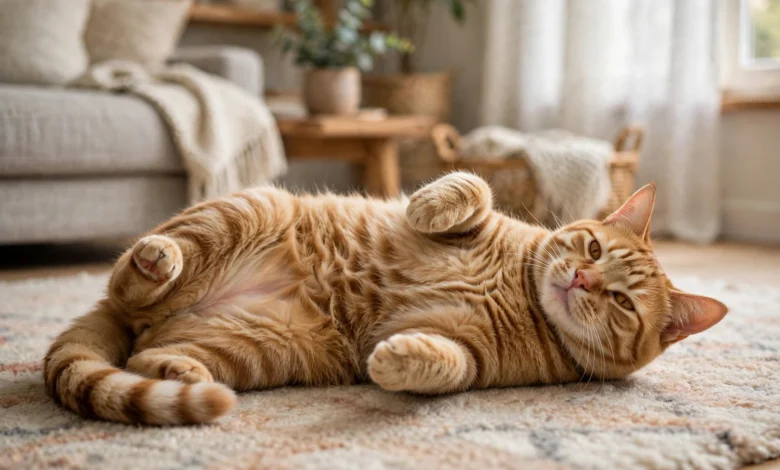
The signs that a cat is in heat are almost entirely behavioural, which is another reason owners confuse the cycle with something physical like a period. During estrus, a cat typically becomes unusually affectionate, rubbing against people and furniture, rolling on the floor, and raising her hindquarters with her tail held to one side when stroked along the back. She will call for a mate with loud, persistent yowling that often continues through the night, and she may try to escape the house, pace restlessly, and lose interest in food for a few days. Some cats also urinate more often or outside the litter box, and their urine may smell stronger than usual.
These behaviours can be intense, and they are also the reason many owners seek help during the breeding season. The yowling in particular is hard to sleep through, and the escape attempts are a genuine risk, because a determined queen can slip through a door or window in seconds. It helps to remember that the behaviour is hormonal, not naughtiness, and scolding the cat will not stop it. Keeping her indoors, providing distraction and play, and speaking to your vet about spaying are the practical responses, and the behaviour will settle once the cycle ends or once she is spayed.
Is Bleeding Normal for a Cat in Heat?
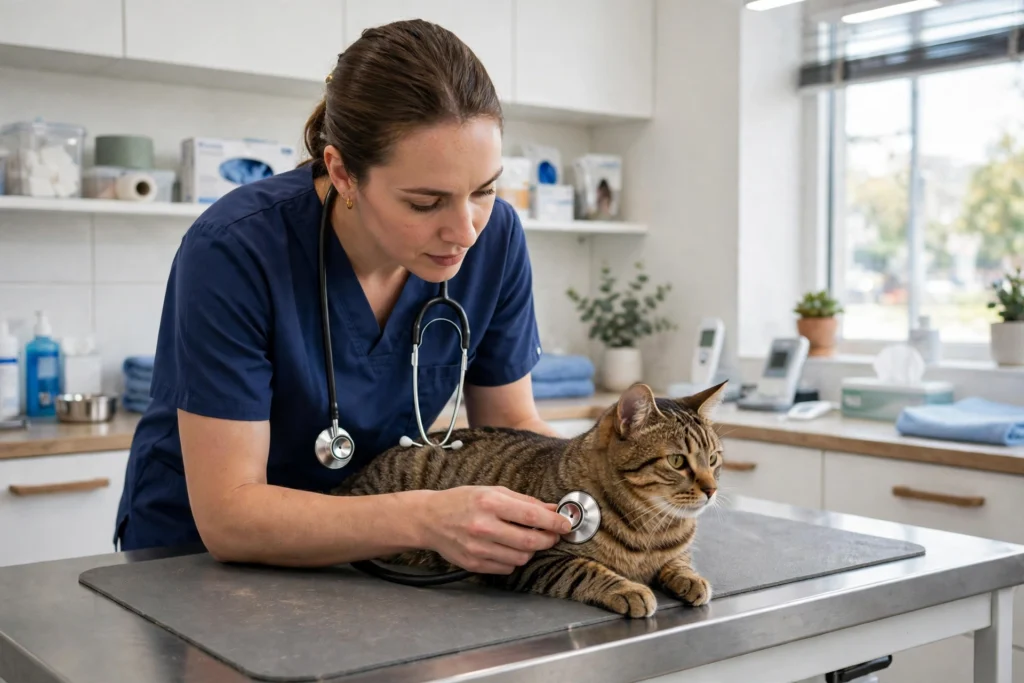
Bleeding is not normal for a cat in heat, and this is the point on which veterinary sources are most emphatic. A healthy queen does not bleed from the vulva during her cycle, because her body reabsorbs the uterine lining instead of shedding it, and vaginal bleeding is never seen in a normal, healthy cat when she is in heat. A very small amount of light discharge is occasionally reported, but it is uncommon and very light, and it should never be mistaken for a period. If you notice significant or persistent bleeding from your cat, treat it as a medical issue and contact your veterinarian promptly.
There are several possible causes of bleeding in a female cat, and none of them is a normal period. Blood from the vulva can indicate a urinary tract infection, a vaginal or uterine disease such as pyometra, trauma, or a blood clotting problem, and some of these conditions are serious and time-sensitive. Pyometra, a severe infection of the uterus, is a particular risk in older unspayed cats and can become life-threatening quickly. The rule is simple: any bleeding that you can see, any discharge with a bad smell, or any combination of bleeding with lethargy, loss of appetite or a swollen abdomen means a vet visit, not a wait-and-see approach.
How to Manage a Cat in Heat
Managing a cat in heat is mostly about keeping her safe and comfortable until the cycle passes, because there is no home remedy that stops the hormonal drive. Owners who first ask “do cats get periods” often arrive at this stage of the problem, having already noticed the yowling and restlessness, and the practical answer is the same: keep her strictly indoors, with windows and doors secured, since a queen in heat is highly motivated to find a mate and can escape through surprisingly small gaps. Provide extra play and attention to burn off restless energy, keep her litter box clean and accessible, and try to maintain a calm, predictable routine, because stress can make the behaviour worse. Some owners find that a warm towel or a heated blanket in her favourite resting spot helps her settle, and keeping the room dim and quiet in the evening can reduce the night-time calling.
Do not be tempted by unproven remedies, hormonal treatments bought online, or anything that claims to suppress heat without veterinary supervision, because these can carry real risks. Your vet can discuss safe options, and the most reliable long-term answer remains spaying, which ends the cycle entirely. If you need to wait before spaying, your vet can advise on timing, and in the meantime, patience and secure doors are your best tools. Remember that the behaviour is temporary and will pass within days, even if those days feel very long at three in the morning.
Should You Spay Your Cat?
Spaying is the single most effective step an owner can take, and vets recommend it for the great majority of pet cats. The procedure removes the ovaries and uterus, which eliminates the heat cycle completely, along with the yowling, the restlessness, the escape attempts and the risk of unwanted pregnancy. It also reduces the risk of serious health problems, including uterine infections such as pyometra and certain types of mammary cancer, and it removes the risk of ovarian disease entirely. For a cat that will never be bred, there is no health benefit in letting her go through repeated heat cycles, and each cycle adds stress for both the cat and the household.
The timing is a decision to make with your vet, but many vets recommend spaying before the first heat, often at around five to six months of age, because a cat can become pregnant on her very first cycle. The surgery itself is routine, recovery is usually quick, and most cats are back to normal within a week or so. If cost is a concern, many animal charities and veterinary practices offer low-cost spaying programmes, so it is worth asking your local practice or rescue centre. Spaying is also the responsible choice for the wider cat population, because unplanned litters are one of the main reasons rescue centres are overwhelmed every spring and summer.
Conclusion
So, do cats get periods? No, they do not, and understanding why clears up a lot of confusion for cat owners. Your cat’s cycle is an estrous cycle, not a menstrual one: she comes into heat, shows it through behaviour rather than bleeding, and repeats the cycle every few weeks during the breeding season until she is mated or spayed. Anyone still wondering “do cats get periods” after reading this should remember the simplest test: a healthy cat in heat never bleeds, so blood is always a vet matter, never a period.
If your cat is in heat right now, the practical steps are simple: keep her indoors, give her extra attention and play, and book a vet appointment to discuss spaying. That one decision ends the cycle, removes the risk of unwanted litters, and protects her from several serious health problems. And if you ever notice bleeding, discharge, lethargy or a swollen abdomen, do not wait for the cycle to pass, because those signs mean something else is going on. A little knowledge about the feline cycle goes a long way, and now you have it.
At what age do cats start their periods?
Cats do not have periods, but they do start their heat cycles young. Most female cats have their first heat at around six months of age, and some begin as early as four to six months. Because a cat can become pregnant on her very first heat, vets often recommend spaying before that first cycle, usually at around five to six months old. If you adopted a kitten and are unsure of her exact age, your vet can estimate it from her teeth and size, and can book the spaying appointment at the right time so the first heat never happens.
How long does a cat stay in heat?
A cat stays in heat for about seven days on average, with a reported range of roughly three to fourteen days. If she does not mate, she will come into heat again after a gap of one to two weeks, and this can repeat every two to three weeks throughout the breeding season. The exact length varies from cat to cat, and some queens stay in heat for as little as three days while others continue for two weeks, so the average of about a week is only a rough guide for planning.
Do male cats have periods?
No, male cats do not have periods, and they do not have a heat cycle either. Male cats are sexually mature from around six months of age and remain fertile year-round, and their behaviour is driven by the presence of females in heat nearby rather than by any cycle of their own. Neutering is the equivalent step for males and reduces spraying, roaming and fighting. An unneutered male will respond to females in heat nearby by spraying, yowling, and trying to roam, and neutering calms those behaviours while also preventing unwanted litters in the neighbourhood.
Can a cat get pregnant on her first heat?
Yes, a cat can become pregnant on her very first heat, which can happen as early as four to six months of age. This is one of the main reasons vets recommend spaying before the first cycle, and why an unspayed young female should be kept indoors once she approaches five months old. This is why rescue centres see so many surprise litters each spring, and why vets advise keeping a young female indoors from around five months old until she has been spayed.
Do indoor cats go into heat?
Yes, indoor cats go into heat, and they may actually cycle more often than outdoor cats. The heat cycle is triggered by daylight, and indoor cats live under artificial light all year, so they may keep cycling through the winter when outdoor cats would rest. Spaying is the only way to stop the cycle. Artificial lighting in a home mimics the long days of summer, which keeps the hormonal cycle going, so an indoor cat may cycle through the winter while outdoor cats rest during the short days.
Why is my cat yowling all night?
Night-time yowling in an unspayed female cat is usually a sign that she is in heat and calling for a mate. The behaviour is hormonal and peaks during estrus, which lasts about a week. Keeping her indoors, giving her extra play during the day, and speaking to your vet about spaying are the practical responses, and the calling should settle once the cycle ends. The calling is loudest at night because cats are naturally more active after dark, and earplugs and a closed bedroom door are the only practical help until the cycle ends or she is spayed.
