When you search for truck repair near me, you are not really looking for the closest garage, and you are looking for the closest garage that can actually fix your truck, charge you fairly, and send you back on the road safely. That distinction matters more with trucks than with cars, because a heavy-duty diesel truck is a complex commercial machine, and a shop that is brilliant with family cars may have neither the equipment nor the training to diagnose a modern diesel engine, its emissions system, or its air brakes. The right shop will ask about your engine make, confirm it has the diagnostic software for it, give you a written estimate before starting work, and warranty the repair in writing. This guide explains how to tell that shop apart from the ones that will waste your time, overcharge you, or send you away with the same fault still present.

The problem with a plain “near me” search is that every listing looks the same, with similar star ratings, similar photos, and similar promises, while the things that actually determine a good outcome are invisible from the search results page. You cannot see whether the technicians hold the right certifications, whether the shop stocks parts for your engine, or whether its idea of a diagnosis is a proper scan or an expensive round of guesswork. That is why this article focuses on the checks you can make in a single phone call and a quick look at reviews, because ten minutes of vetting before you book can save you days off the road and a bill that is far larger than it needed to be. Whether you drive your own rig or manage a small fleet, the method below works the same way.
Truck Repair Near Me: What the Search Really Means
Truck repair near me is a search people make in two very different situations, and recognising which one you are in changes everything about how you should use the results. In the first situation, you are broken down at the roadside or in a layby, the truck will not move, and speed matters more than anything else, so the right result is a mobile mechanic or a 24-hour shop that can reach you quickly and stabilise the vehicle. In the second situation, you are planning ahead, perhaps for a service, a DOT inspection, or a fault that is getting worse but has not yet stopped the truck, and here you have time to compare shops, read reviews properly, and choose on quality rather than proximity. Most bad truck repair experiences come from treating a planned job like an emergency, or an emergency like a planned job, so the first step is always to be honest with yourself about which situation you are actually in.
The second thing the search does not tell you is what kind of truck repair the shops in the results actually do, because “truck repair” covers everything from a pickup truck oil change to a full engine rebuild on a Class 8 semi, and many shops only handle part of that range. A garage that mainly services light pickups may advertise itself as a diesel specialist while having no experience with the air brake systems, aftertreatment, and electronic controls of a heavy commercial vehicle, and that gap only becomes obvious once your truck is already on their ramp. Before you commit to any shop, ask directly whether it works on your class of vehicle and your engine family, whether that is Cummins, Detroit, PACCAR, Volvo, or International, because a shop that answers that question confidently and specifically is already a better bet than one that answers with a vague reassurance. The right shop for your truck is the one that does your kind of work every day, not the one that happens to be nearest.
Emergency Breakdown or Planned Maintenance?
If your truck has stopped and you cannot move it, your priorities narrow to three things: safety, speed, and a repair that will actually hold until you reach a proper workshop. Get the vehicle somewhere safe if you possibly can, put your hazards and warning triangles out, and then call a mobile truck repair service or a 24-hour heavy-duty shop rather than a general garage that opens at nine in the morning. Mobile mechanics are well suited to roadside stabilisation, handling faults such as air line leaks, alternator failures, and brake problems without a full workshop, but they cannot replace a lift, a press, or a controlled workshop environment for major component work. A good mobile technician will tell you honestly when a roadside fix is enough to get you moving and when the truck needs to be towed to a shop, and that honesty is itself a sign of a trustworthy operator.
Planned maintenance is a completely different game, and it rewards patience in a way that emergency work cannot, because you have time to build a relationship with a shop before you actually need it in a crisis. The smartest move for any owner-driver or small fleet is to find your regular shop while the truck is running well, starting with a routine service or inspection, so that you already know the people, the pricing, and the quality of the work before a breakdown forces the decision on you. A shop that does your preventive maintenance properly will also know your truck’s history when something goes wrong, which makes diagnosis faster and cheaper, and it will be far more willing to prioritise you as an existing customer than as a stranger calling at midnight. Think of it as choosing a doctor before you are ill, rather than in the middle of an emergency, because the logic is exactly the same.
Truck Repair Near Me: How to Vet a Shop Before You Book
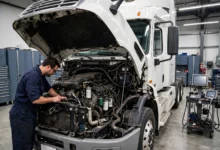
Truck repair near me searches return dozens of options, so vetting them quickly comes down to a short checklist you can run through in one phone call, starting with the most important question of all: do you service my engine and my truck? A good shop will answer with specifics, naming the engine families it works on and the technicians who hold the relevant certifications, while a weak shop will answer in generalities and change the subject to pricing. Next, ask about diagnostic capability, because modern trucks run on complex electronics, and a shop should be able to pull fault codes with up-to-date diagnostic software for your specific make before it starts replacing parts. If a shop cannot explain why a warning light is on before it starts work, it is guessing, and guessing with your money is not a service you should pay for.
Reviews are the next filter, but they need to be read properly rather than just glanced at, because a 4.8-star rating means very little on its own. Look for reviews written by people who clearly drive commercial trucks, mentioning turnaround time, specific repairs, and whether the shop was upfront about pricing, and pay attention to how the business responds to negative reviews, because a shop that answers complaints professionally is usually a shop that takes its reputation seriously. Also check whether the shop is easy to reach from your regular routes or your terminal, since a good shop that is a two-hour tow away is less useful than a good shop near your base, and confirm its opening hours, including whether it offers genuine 24-hour cover or simply an out-of-hours phone number. By the end of one call and ten minutes of reading, you should have a clear sense of whether this is a professional heavy-duty operation or a general garage that happens to own a large ramp.
Certifications and Diagnostics That Actually Matter
The certification that matters most in heavy-duty truck repair is the ASE Medium/Heavy Truck credential, which runs across the T-series exams, with T2 covering diesel engine diagnosis and repair, T4 covering braking systems, T6 covering electrical and electronic systems, and T8 covering preventive maintenance inspection. Technicians must document two years of hands-on experience and pass the relevant exams, and certification must be renewed by retesting every five years, according to ASE itself, which means the credential is a live measure of competence rather than a one-time badge. The practical question to ask is not whether the shop is ASE certified in general, but which technician holds which certificate and whether it matches the systems on your truck, because a brake specialist and an engine specialist hold different qualifications, and your fault needs the right one. Manufacturer training from engine makers such as Cummins, Detroit, and PACCAR matters too, because it gives technicians access to proprietary diagnostic software, factory service procedures, and technical support that generic training cannot replicate.
Diagnostics are the other half of competence, and they are where the gap between a good shop and a poor one is widest, because a modern diesel truck is effectively a computer network on wheels. The engine control module, the diesel particulate filter, the selective catalytic reduction system, and the transmission all communicate over networks such as J1939 and CAN, and a shop without current OEM software and proper access to those networks cannot reliably diagnose emissions faults or engine control problems. Ask directly whether the shop can perform a forced regeneration on a diesel particulate filter, whether it can read manufacturer-specific fault codes rather than generic ones, and whether it stocks or can quickly obtain OEM parts for your engine, because waiting days for a special-order part is often what turns a one-day repair into a week off the road. A shop that answers these questions fluently is a shop that works on trucks like yours every day, and that fluency is worth more than any advertising claim.
What Truck Repair Costs and How Estimates Should Work
Truck repair costs vary so widely that no single figure is meaningful without knowing the fault, the truck, and the parts involved, but there are reliable rules about how the pricing should be presented. A reputable shop will always give you a written, itemised estimate before work begins, breaking out parts, labour, and any diagnostic charges separately, and it will ask for your authorisation before exceeding the agreed scope, rather than presenting you with a surprise at the end. Small jobs such as a single injector replacement can still reach four figures, and delaying a small fault can turn it into a major one, with a neglected injector problem capable of becoming a cylinder head job costing $5,000 to $10,000 or more, according to the Truck Repair Cost Guide 2026 published by Albert’s Road Service. That is why a cheap diagnosis that misses the real fault is no bargain at all, and why the cheapest quote is often the most expensive repair in the end.
Warranties are the other half of the money question, and they separate serious shops from the rest more clearly than almost anything else. A reputable provider should give you its warranty terms in writing, covering both parts and labour, and a written warranty of at least 90 days is a reasonable minimum to expect on a heavy-duty repair, with longer cover on major work such as engines and transmissions. If a shop will not put its warranty in writing, or if it offers only a vague verbal promise, treat that as a warning sign and take your truck elsewhere, because a shop that stands behind its work has no reason to avoid writing it down. For major repairs, it is also worth getting estimates from more than one shop, not to play them off against each other, but to establish what a fair price actually looks like, since a quote that is far below the others usually means something important has been left out of it.

The way a shop talks about money before the work starts tells you a great deal about how it will behave after the work is done, so listen carefully during that first conversation. A good shop will explain what it knows, what it does not yet know, and what the diagnostic step will cost before any repair is agreed, while a poor shop will quote a firm price for a repair it has not yet diagnosed, which is a promise it cannot honestly keep. Ask whether the diagnostic fee is deducted from the repair bill if you go ahead, ask how it handles parts that turn out to be unnecessary, and ask for the old parts back so you can see what was actually replaced. None of these questions is confrontational, and a professional shop will welcome them, because they are the questions an experienced fleet manager asks every time, and they are the questions that keep honest shops in business.
Mobile Truck Repair or a Fixed Workshop?
Mobile truck repair and fixed workshops are not competitors but complements, and understanding which one fits your situation is the key to using both well. A mobile mechanic comes to you, which makes it the right choice for a roadside breakdown, a fault at a loading bay, or a repair at your own yard that does not need heavy equipment, and the best mobile operators carry proper diagnostic tools, common parts, and the experience to stabilise a truck safely. What a mobile service cannot offer is a lift, a press, a clean workshop, or the controlled environment that major component work requires, so engine rebuilds, transmission work, and anything needing precise measurement belongs in a fixed workshop. The right question is therefore not which option is better in general, but which one fits the specific fault in front of you, and a good operator of either type will tell you honestly when the job belongs to the other.
The most practical arrangement for most drivers and small fleets is to have both: a trusted fixed workshop for services, inspections, and major repairs, and a reliable mobile mechanic for emergencies and on-site work. That combination gives you a relationship with a shop that knows your truck’s history, plus a lifeline when the truck stops somewhere the shop cannot reach, and it means you are never forced to choose a stranger in a hurry. When you are comparing mobile services, check that they carry proper insurance, that they can diagnose your engine family, and that they will give you a written invoice and warranty for the work, because a mobile repair deserves the same paperwork as a workshop repair. If you operate in the UK and want a sense of what a full-service local garage offers, our look at Maghull Motorist Centre, a trusted MOT, car service and repairs centre in Liverpool, shows the kind of organised workshop, clear services, and local reputation that are worth looking for in a truck repair shop too.
Red Flags That Should Make You Walk Away
Some warning signs are obvious once you know to look for them, and the first is a shop that will not give you a written estimate, because a business that will not write down its price is a business that plans to change it. A second is a shop that diagnoses a major repair over the phone without seeing the truck, or that insists on replacing several expensive parts at once without explaining why each one is needed, since proper diagnosis is a process, not a guess, and a good technician will show you the fault codes and the test results behind the recommendation. A third is a workshop that looks chaotic, with parts scattered everywhere, no proper diagnostic equipment visible, and no clear system for tracking your vehicle, because a shop that cannot organise its own floor is unlikely to organise your repair well either. None of these signs proves a shop is dishonest, but together they are a strong reason to take your truck somewhere else.
Other red flags are subtler but just as telling, such as a shop that refuses to return your old parts, that will not explain its warranty in writing, or that pressures you to authorise additional work immediately without giving you time to think. Reviews can also reveal patterns, particularly repeated complaints about the same issue, such as bills that grow after the estimate, repairs that need doing twice, or trucks returned with new faults that were not there before. It is also worth being cautious of a shop that is dramatically cheaper than every competitor, because heavy-duty parts and skilled labour have a real cost, and a price far below the market usually means cut corners, pattern parts passed off as OEM, or a diagnosis that has not actually been done. Trust your instincts as well: if the people you deal with are evasive, rushed, or unwilling to answer straightforward questions, that is information, and you should act on it.
What to Have Ready Before You Call a Shop
A repair goes faster, and usually cheaper, when you arrive with the right information, because the shop can start diagnosing instead of spending its first hour finding out what truck it is working on. Have the make, model, and year of the truck ready, along with the engine make and model, the VIN, and the current mileage, and be able to describe the fault in plain terms: when it started, whether it happens hot or cold, what sounds or smells you noticed, and which warning lights are showing. If the truck has already had diagnostic codes read, bring those codes with you, and if it has had recent work done, bring the invoices, because a fault that appeared shortly after a previous repair is a vital clue. A driver who can say “it loses power above 1,500 rpm, the check engine light is on, and it started after the last service” will get a faster and more accurate diagnosis than one who can only say “it doesn’t feel right.”
It also helps to know what you need from the shop before you call, so you can ask for it directly rather than discovering halfway through that the shop cannot provide it. If you need a DOT inspection, say so, because that requires specific inspection authority under the US FMCSA rules in 49 CFR Part 396, or the equivalent commercial vehicle inspection authorisation in your own country, and not every repair shop holds it. If you need the truck back by a deadline, say that too, and ask honestly whether the shop can meet it, because a shop that promises a date it cannot keep is worse than one that tells you the truth about a longer wait. Finally, agree the authorisation limit in advance, meaning the amount the shop may spend without calling you first, so that a small job cannot quietly become a large one while you are waiting for a phone call that never comes.
Conclusion
Finding good truck repair near you is not really about distance, and it is about finding a shop with the right certifications, the right diagnostic equipment, honest written estimates, and a warranty it is willing to put on paper. The checks in this guide take minutes, yet they separate the professional heavy-duty operations from the general garages that will cost you time and money, and they work whether you are broken down at the roadside tonight or planning a service for next month. Ask about your engine family, ask which technician holds which ASE certificate, ask what the diagnostics can actually see, and read the reviews for what truckers themselves say about turnaround and honesty, because those four answers will tell you almost everything you need to know.
The best time to find that shop is before you need it, so use your next routine service as a trial run, and build the relationship while the truck is running well. That way, when a breakdown does happen, you are calling people who know you and your truck, rather than searching frantically for a stranger with a star rating and a phone number. Keep this guide saved, keep your truck’s details written down where you can reach them, and remember that a good repair shop is a business partner in keeping you earning, not just a bill to be paid. As of November 2026, the standards described here, from ASE certification to written warranties, are the marks of a professional heavy-duty repairer on both sides of the Atlantic, and any shop that meets them is a shop worth trusting with your truck.
How do I find truck repair near me at night?
To find truck repair near you at night, search specifically for 24-hour diesel repair or 24-hour mobile truck mechanics rather than general garages, and call ahead to confirm the service is genuinely operating, not just an out-of-hours voicemail. Give the operator your location, truck make and engine type, and a clear description of the fault, and ask whether it can reach you, what the call-out charge is, and whether it can stabilise the truck or tow it to a workshop. Mobile mechanics can handle many roadside faults, such as air line leaks, alternators, and brake issues, but major component work will still need a fixed workshop, so ask honestly whether a roadside fix will hold or whether a tow is the safer option.
How much does truck repair usually cost?
Truck repair costs vary too widely for a single useful figure, because the price depends on the fault, the truck, and the parts involved, but the structure of a fair bill is always the same: a written, itemised estimate covering parts, labour, and diagnostics, agreed before work begins. Small jobs such as a single injector replacement can still reach around $1,000, while neglecting a small fault can turn it into a major one, with a cylinder head job costing $5,000 to $10,000 or more, according to the Truck Repair Cost Guide 2026 published by Albert’s Road Service. Always get the estimate in writing, agree an authorisation limit for extra work, and compare quotes from more than one shop for any major repair.
What is the difference between a diesel mechanic and a truck mechanic?
A diesel mechanic specialises in diesel engines, while a truck mechanic works on the whole vehicle, and in heavy-duty repair the two roles overlap but are not identical. Diesel engine work covers the engine itself, fuel injection, turbocharging, and emissions aftertreatment, while truck work also covers air brakes, suspension, steering, transmissions, and electrical systems, which is why ASE splits its Medium/Heavy Truck certifications across the T-series, with T2 for diesel engines, T4 for brakes, T6 for electrics, and T8 for preventive maintenance. When choosing a shop, ask which technician holds which certificate and whether it matches the system that needs repair on your truck, because the right specialist depends on the fault.
Should I choose a dealer or an independent truck repair shop?
Neither a dealer nor an independent shop is automatically better, and the right choice depends on your truck, your warranty, and the job in hand. Dealers have factory training, OEM diagnostic software, and genuine parts for their own makes, which makes them strong for complex electronic faults and warranty work, but they are often more expensive and slower to book. Good independents can be cheaper, faster, and more flexible, and many hold the same ASE certifications and OEM-level diagnostic tools, but quality varies far more between independents, so you need to vet them carefully using the checks in this guide. For trucks still under warranty, a dealer is usually the safer choice, while for older trucks an independent specialist is often better value.
How long does a typical truck repair take?
How long a truck repair takes depends on the fault and on parts availability, with simple jobs such as a sensor replacement or a brake adjustment often finished the same day, while diagnostics, parts ordering, and major component work can take several days. The most common cause of delay is not the repair itself but waiting for parts, which is why you should always ask whether the shop stocks parts for your engine or will need to order them, and how long that order will take. A good shop will give you an honest time estimate before starting, keep you updated if it slips, and prioritise getting you a safe, roadworthy truck rather than promising a date it cannot meet.