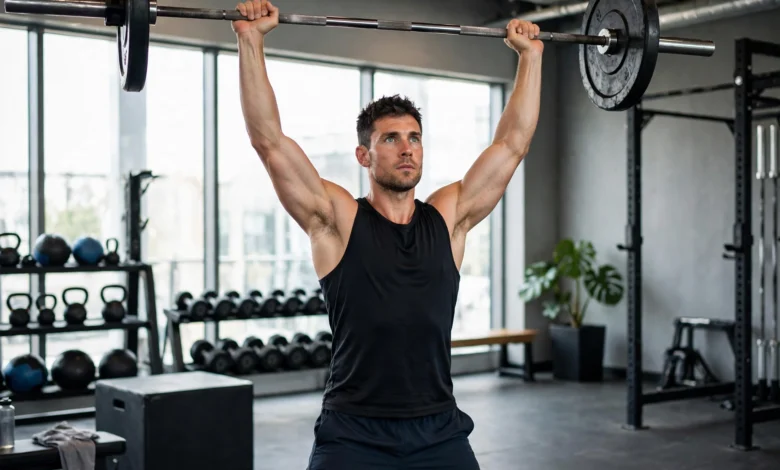
Military Press Muscles Worked: What This Classic Lift Really Trains
The military press muscles worked are led by the front deltoids, with strong help from the triceps, upper chest and trapezius, plus the core and rotator cuff working hard to stabilise the body while the bar travels overhead. The military press is a strict standing barbell press from the upper chest to a full overhead lockout with no leg drive, and because it is performed standing up, it trains far more than just the shoulders, which is why it has been a staple of strength training for decades. This guide breaks down every muscle the military press works, explains how to perform it with correct form, and shows how to programme it for strength or size.

It is worth understanding exactly which muscles do the work, because the military press is often described simply as a shoulder exercise, and that description misses most of what makes it valuable. The front of the shoulder does the heaviest lifting, but the triceps finish the press, the upper chest helps at the start, the traps shrug the bar into its final position, and the core, glutes and even the legs work to keep the body rigid under a heavy bar overhead. Knowing this breakdown helps you choose the right assistance exercises, spot the weak link when your press stalls, and train the lift safely without overloading the lower back or the shoulder joint.
What Is the Military Press?
The military press is a strict standing barbell press in which you press a barbell from your upper chest to a full lockout overhead without using any leg drive, backward lean or other body momentum to help the weight up, and that strictness is what separates it from the push press, which uses a dip and drive from the legs. The lift starts with the bar resting across the front of your shoulders, your elbows pointing forward and your forearms vertical, and it finishes with the bar directly over your shoulder joint, your arms straight and your traps shrugged up to support the weight. In its strictest traditional form, the heels are kept together, although most lifters today use a shoulder-width stance, which is more stable and still counts as a strict press as long as the knees stay straight and the legs do not drive.
The military press is also known as the overhead press or the strict press, and it is one of the oldest barbell lifts, once part of Olympic weightlifting competition before it was removed in 1972, which is why it still carries a reputation as a test of genuine upper-body strength. Unlike a seated shoulder press, the standing military press forces your whole body to work as a single unit, because a heavy bar overhead is inherently unstable, and your core, glutes and legs must brace hard to keep your spine in a safe position while your arms drive the weight up. That full-body demand is exactly why the lift builds such useful, transferable strength, and why it remains a favourite of lifters, CrossFitters, strongman athletes and military personnel who need to press heavy loads overhead in the real world.
What Muscles Does the Military Press Work?
The military press muscles worked cover a wide area of the upper body, and the breakdown from ExRx, the exercise database used by coaches and researchers, lists the front deltoid as the target muscle, with the side deltoid, upper chest, triceps, middle and lower traps, serratus anterior and coracobrachialis as the helper muscles that assist the press. The dynamic stabilisers, the muscles that control the movement as it happens, are the long head of the triceps and the short head of the biceps, while the upper traps and levator scapulae act as stabilisers that hold the shoulder girdle in position throughout the lift. This is a compound, multi-joint exercise, which means it trains several muscles across several joints at once, and that is why it is so efficient for building upper-body strength and size compared with isolation exercises that work one muscle alone.
What makes the list interesting is how much of the body is involved beyond the obvious shoulder muscles, because the standing position turns the lift into a full-body effort, and the core muscles of the midsection must work extremely hard to keep the spine locked in a neutral position while a heavy bar travels overhead. The glutes squeeze to keep the hips still and prevent the lower back from arching, the legs provide a solid base, and the rotator cuff, a group of four small muscles deep inside the shoulder joint, works constantly to keep the head of the upper arm bone securely seated in its socket as the arm rotates overhead. Even the muscles of the upper back play a role, because the shoulder blades must rotate upward and the traps must shrug to let the arms reach a full, stable lockout at the top of the movement.
How Do the Deltoids Work During a Military Press?
The deltoids are the primary muscles of the military press, and of the three heads of the deltoid, the front or anterior deltoid does the most work, because it is the muscle that lifts the arm forward and upward, which is exactly the path the bar takes from the chest to overhead. When you press the bar up from your shoulders, the front deltoid contracts hardest through the first half of the movement, driving the upper arm forward and up, and it stays active all the way to lockout, which is why lifters who train the military press consistently develop noticeably fuller front shoulders. The front deltoid is the target muscle of the lift according to ExRx, and it is the muscle that limits how much weight most people can press, so strengthening it is the key to a bigger military press.
The side or lateral deltoid also contributes, although it works less hard than the front head during a barbell press, because the elbows stay relatively close to the body and the arms travel in front of the torso rather than out to the sides. Research and coaching experience agree that the dumbbell shoulder press, where the elbows flare out more, stimulates the side deltoid more strongly than the barbell version, which is why lifters who want fully developed shoulders usually pair the military press with a lateral raise or a dumbbell press for the side head. The rear or posterior deltoid gets only a small amount of stimulation from pressing, because its main job is pulling the arm backwards, so it needs dedicated pulling work such as rows and reverse flyes to grow, and no pressing movement on its own will build the rear delts properly.
What Role Do the Triceps and Upper Chest Play?
The triceps play a crucial role in the military press, because while the deltoids start the movement, it is the triceps that finish it, straightening the elbows to drive the bar through the final part of the press and into a full lockout overhead. The long head of the triceps is particularly important, because it crosses the shoulder joint as well as the elbow, which means it helps to stabilise the shoulder while also extending the arm, and this dual role is why the triceps are listed as both a helper muscle and a dynamic stabiliser of the lift. Lifters who stall near the top of the press, with the bar stuck a few inches short of lockout, are usually limited by triceps strength rather than shoulder strength, and adding close-grip bench presses or overhead triceps work is often the fastest way to break through that sticking point.
The upper chest, specifically the clavicular head of the pectoralis major, also assists the press, particularly in the first part of the movement when the bar leaves the shoulders and the arms begin to drive upward and slightly forward. The contribution of the chest is modest compared with a bench press, but it is real, and it is one reason the military press feels different from a pure shoulder isolation exercise, because the upper chest helps to initiate the drive. The trapezius completes the picture, because the upper traps pull the shoulder girdle upward as the bar approaches lockout, and the middle and lower traps help to rotate the shoulder blades so the arms can reach a full, stable overhead position, which is why a strong shrug at the top is a hallmark of good military press technique.
How Do You Perform a Military Press With Correct Form?
Performing a military press with correct form starts with the set-up, because a good press is built before the bar ever leaves the rack, and the bar should be set in a rack at about shoulder height so you can step under it without losing your balance. Take an overhand grip slightly wider than shoulder width, with your forearms vertical when the bar rests across the front of your shoulders, then step back into a shoulder-width stance, squeeze your glutes and brace your abs as if someone were about to poke you in the stomach, and keep your chest up with your elbows pointing forward. Your knees should stay straight throughout the lift, because bending them to drive the bar up turns the strict military press into a push press, which is a different exercise entirely.
To press, drive the bar straight up in a vertical line close to your face, tucking your chin back slightly as the bar passes, and once the bar clears your face, let your shoulders move forward underneath it so the bar finishes directly over your shoulder joint, with your ears in line with your biceps and your traps shrugged up. Exhale as the bar reaches lockout, hold the position briefly with your arms fully straight, and then lower the bar back to your shoulders slowly and under control, resetting your brace before the next repetition. Common mistakes to avoid include leaning back excessively, which loads the lower back and turns the lift into an incline press, flaring the elbows too wide, which stresses the shoulder joint, and letting the bar drift forward away from the body, which makes the lift much harder and less stable than it needs to be.
What Are the Best Military Press Variations?
The best military press variations let you train the same muscles from different angles or with different equipment, and the seated military press is the most popular alternative, because sitting down removes the balance and core demand and lets you focus purely on pressing, which can be useful when your lower back is tired or you want to push the shoulders harder without worrying about stability. Each of these variations trains the same military press muscles worked by the barbell version, although the emphasis shifts slightly from one variation to the next, and the dumbbell press in particular gives the side deltoid more work than the barbell does. The dumbbell military press is another excellent variation, because each arm works independently, which corrects strength imbalances between the left and right sides and allows a slightly wider elbow position that stimulates the side deltoid more than the barbell version. The Arnold press, named after Arnold Schwarzenegger, adds a rotation to the movement, starting with the palms facing you and rotating them forward as you press, which trains the deltoids through a larger range of motion.
The behind-the-neck military press is a more advanced variation that some experienced lifters use, although it demands excellent shoulder mobility and is not suitable for everyone, because pressing behind the head places the shoulder joint in a more vulnerable position. The Smith machine military press offers a guided bar path that can help beginners learn the movement pattern, although it removes the stabilising work that makes the free barbell version so effective. For lifters with shoulder issues, the landmine press and the single-arm dumbbell press are gentler alternatives that still train the pressing muscles without forcing the shoulder into a fully overhead position, and a qualified coach can help you choose the variation that fits your body and your goals.
How Should You Programme the Military Press?
Programming the military press depends on your goal, and the most common starting points are three sets of five repetitions for strength and six to twelve repetitions per set for muscle size, with two to three minutes of rest between heavy sets so you can recover enough to press with good form. A good programme targets all of the military press muscles worked in the lift, including the triceps and the upper back, because a weak link in either area will eventually limit how much you can press overhead, and assistance work for those muscles is what breaks a plateau. Beginners often progress fastest by pressing twice a week, adding a small amount of weight each session, because the military press responds well to frequent, consistent practice, and the lift is light enough compared with the squat or deadlift that it recovers quickly. As you get stronger, you may need to slow the progression down and add assistance work for the triceps and upper back, because a weak link in either area will eventually limit how much you can press overhead.
A sensible weekly plan might pair the military press with a horizontal press such as the bench press on one day and a pulling movement such as a barbell row on another, because balanced training keeps the shoulders healthy and prevents the front of the shoulder from becoming overdeveloped relative to the back. Warm up thoroughly before heavy pressing, starting with the empty bar and building up in small jumps, and always stop a set when your form breaks down rather than grinding out ugly repetitions with an arched lower back. If pressing overhead hurts your shoulder or lower back, stop the lift and talk to a doctor or a qualified coach, because pushing through shoulder pain is one of the fastest ways to turn a minor irritation into a long-term injury, and there is always a variation or an alternative that lets you train around the problem.
Conclusion
The military press muscles worked are the front deltoids first and foremost, with the triceps, upper chest, traps, serratus anterior and coracobrachialis assisting, and the core, glutes, legs and rotator cuff stabilising the body throughout the lift, which is why this strict standing press builds such complete upper-body strength. Performed with a vertical bar path, a braced core and a full lockout overhead, the military press is one of the most effective lifts for building strong, capable shoulders, and programmed at three sets of five for strength or six to twelve repetitions for size, it fits into almost any training week. This article is general fitness information, not medical advice, so if pressing overhead hurts your shoulder or lower back, stop and speak to a doctor or a qualified coach.
Is the Military Press the Same as the Overhead Press?
The military press is a type of overhead press, and the two terms are often used interchangeably, but the military press is specifically the strict standing barbell version with no leg drive, while overhead press is a broader term that also covers push presses, seated presses and dumbbell presses. In the strictest traditional form of the military press the heels are kept together, although most lifters today use a shoulder-width stance and still call it a military press as long as the knees stay straight and the legs do not drive the bar up.
What Muscles Does the Military Press Work the Most?
The military press works the front deltoid the most, according to ExRx, which lists the anterior deltoid as the target muscle of the lift, with the side deltoid, upper chest, triceps, middle and lower traps, serratus anterior and coracobrachialis as helpers. The triceps finish the press by straightening the elbows into lockout, the upper chest helps at the start of the drive, and the core, glutes and rotator cuff stabilise the body throughout, so it is a full upper-body and core exercise rather than a shoulders-only movement.
Is the Military Press Good for Building Shoulders?
Yes, the military press is one of the best exercises for building shoulders, because it allows heavy loading of the front deltoids through a full range of motion and trains them together with the triceps, upper chest and traps in a single compound movement. For fully developed shoulders you should still add work for the side and rear deltoids, such as lateral raises and reverse flyes, because the barbell military press stimulates the side head less than a dumbbell press and barely trains the rear head at all.
How Much Weight Should I Military Press?
How much weight you should military press depends on your strength, bodyweight and experience, and a useful benchmark is that an intermediate lifter can usually strict-press around 60 to 70 percent of their bench press, although this varies widely between individuals. Start with a weight you can press for three sets of five repetitions with clean form and a vertical bar path, add a small amount each week, and stop the set when your form breaks down rather than grinding out repetitions with an arched lower back.
Why Does My Lower Back Hurt When I Military Press?
Your lower back hurts when you military press most often because you are leaning back excessively as the bar goes up, which loads the lumbar spine instead of letting the shoulders and triceps do the work, and the usual fix is to squeeze your glutes, brace your abs, and keep your ribs down throughout the lift. If the pain persists even with good form, or if it is sharp rather than a dull ache, stop pressing overhead and speak to a doctor or a qualified coach, because pushing through back pain can turn a minor problem into a long-term injury.