DOT Physical Near Me: How to Find a Certified Examiner and Pass First Time
A DOT physical near me is a medical exam that commercial drivers must pass before they can legally drive, and the only valid version is one performed by a medical examiner listed on the Federal Motor Carrier Safety Administration National Registry of Certified Medical Examiners. If you drive a commercial motor vehicle in interstate commerce, federal law requires this exam, and the result is reported electronically to your state licensing agency, so there is no shortcut around it and no way to use an exam from an unlisted doctor. The good news is that finding a DOT physical near me is straightforward once you know where to look, because thousands of certified examiners work in occupational health clinics, urgent care centres and truck stop clinics across the country, and most appointments take less than an hour from start to finish.


This guide explains exactly what a DOT physical is, who needs one, what the examiner checks, how to find a certified examiner close to you, what to bring, what it costs, and how long the medical card lasts. It also covers what happens if you do not pass on the first visit, because a deferral is not the end of your driving career, and many drivers pass on a second attempt once they understand what the examiner was looking for. Everything here is general information based on the federal rules in 49 CFR 391.41 and FMCSA guidance as of November 2026, and it is not a substitute for advice from your own doctor or the medical examiner who assesses you.
What Is a DOT Physical and Who Needs One
A DOT physical is a medical examination that checks whether a driver is physically qualified to operate a commercial motor vehicle safely, and it is required by the Federal Motor Carrier Safety Administration for anyone who drives in interstate commerce in a vehicle that meets the federal definition of a commercial motor vehicle. That definition covers vehicles with a gross vehicle weight rating of 10,001 pounds or more, vehicles designed to carry 16 or more passengers including the driver, vehicles carrying 9 or more passengers for hire, and vehicles transporting hazardous materials in quantities that require placarding. If you hold or are applying for a commercial driving licence and drive across state lines, you will need a valid Medical Examiner’s Certificate, and the exam must be done by an examiner on the National Registry, because a regular family doctor cannot issue the certificate unless they have completed the federal certification process.
The reason the rule exists is straightforward, because a driver who suffers a sudden medical event at the wheel of a vehicle weighing tens of thousands of pounds puts everyone on the road at risk, and the examination is designed to catch the conditions most likely to cause that kind of event. The examiner looks at your vision, hearing, blood pressure, heart and lung health, diabetes control, sleep apnoea risk, neurological history and general physical fitness, and then decides whether you meet the federal standards, need a shorter certificate with follow-up, or need further testing before a decision can be made. The certificate is the proof that you are medically qualified, and since 23 June 2025 the result travels electronically from the examiner to FMCSA and then to your state, so for CDL holders the electronic record now controls and the paper card is no longer the proof it once was.
What Does a DOT Physical Check
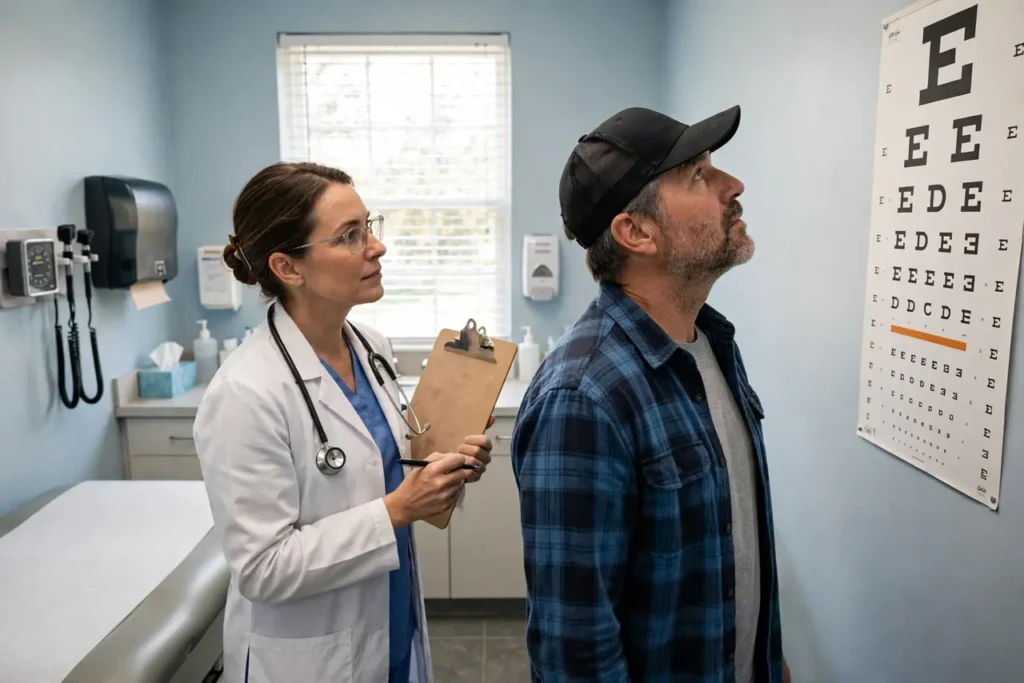
A DOT physical checks you against the standards set out in 49 CFR 391.41, and the examination follows the same federal form at every certified site, so the experience is consistent whether you book at an occupational health clinic, an urgent care centre or a truck stop clinic. The visit starts with a health history form where you list your medications, past surgeries, and any conditions such as heart disease, diabetes, sleep apnoea or seizures, and honesty on this form matters because the examiner can request records or further testing if something in your history needs clarification. The examiner then tests your vision, requiring at least 20/40 distant vision in each eye and both eyes together, with or without glasses or contact lenses, a horizontal field of vision of at least 70 degrees in each eye, and the ability to recognise the red, green and amber of traffic signals.
The hearing check requires you to perceive a forced whispered voice in your better ear at five feet or more, with or without a hearing aid, or to pass an audiometric test showing average hearing loss of no more than 40 decibels in the better ear at 500, 1,000 and 2,000 hertz. Your blood pressure and pulse are measured, a urine sample is checked for protein, blood and glucose as a screen for underlying conditions such as diabetes or kidney problems, and the examiner carries out a physical examination of your heart, lungs, abdomen, spine and neurological function. It is important to understand that the urine check in a DOT physical is a medical screening test and not a drug test, because the federal drug testing rules for drivers are a separate programme with their own procedures, and the two should not be confused when you are preparing for your appointment.
How Do You Find a DOT Physical Near Me
The only reliable way to find a DOT physical near me is to use the FMCSA National Registry search tool, because it is the single official list of every examiner certified to perform the exam, and a clinic advertising DOT physicals is not proof that its examiner is actually listed. Open the registry at nationalregistry.fmcsa.dot.gov, enter your city and state or your ZIP code, and the tool returns certified examiners near that location, and you can also use the advanced search to look up an examiner by name or by their ten-digit National Registry number. Writing down the examiner’s name, business and registry number before you call to book is a sensible step, because it lets you confirm the listing again on the day of the exam, and FMCSA has in the past voided thousands of certificates issued by examiners who were found not to have applied the required standards.
In practice, certified examiners are found in several kinds of setting, and knowing which ones to check widens your options when you need an appointment quickly. Occupational health clinics are often the best bet because DOT physicals are their everyday work and many offer walk-ins or same-day appointments, while urgent care centres frequently have certified examiners on staff and can fit a driver in around other patients. Clinics at major truck stops are convenient if you are already on the road, and some employers have relationships with specific providers, so it is always worth asking your fleet manager or safety department whether the company has a preferred clinic. The key point is to verify the individual examiner on the registry before you book, because a clinic may employ several providers and only some of them may be certified, and the person who actually examines you must be the one who is listed.
What Should You Bring to Your DOT Physical
Bringing the right documents to your DOT physical can be the difference between leaving with a certificate and being deferred while the examiner waits for records, so a little preparation before the appointment pays off. Bring a valid government-issued photo ID and the licence or permit details the examiner asks for, along with a complete and accurate list of every medication you take, including the names, dosages and prescribing doctors, because the examiner needs this to judge whether any medicine could affect your ability to drive safely. If you wear glasses or contact lenses, bring them and your most recent prescription, and if you use a hearing aid, bring that too, because the vision and hearing tests are done with your normal correction in place.
If you have a condition that needs specialist evidence, bring the supporting documents with you rather than hoping the examiner will take your word for it, because a current note from your treating clinician can prevent a deferral. Drivers with diabetes should bring their most recent A1C result, drivers treated for sleep apnoea should bring CPAP compliance data, and drivers with a heart condition or a history of seizures should bring a letter from the relevant specialist. If you have had surgery recently or take insulin, the examiner will need to see that you meet the separate federal standards for those situations, and arriving with the paperwork ready shows the examiner that your condition is being managed. It is also worth taking your regular medications as prescribed on the day of the exam and avoiding a heavy meal or excessive caffeine immediately beforehand, because both can push your blood pressure reading higher than your usual level.
How Much Does a DOT Physical Cost
The cost of a DOT physical varies widely depending on where you go, and the same exam can cost very different amounts in different settings, so it is worth calling ahead and asking for the cash price before you book. Reports from drivers and industry guides put the typical range at roughly 65 to 185 dollars, with rural primary care offices often at the lower end and major metropolitan urgent care centres at the higher end, while some national occupational health chains advertise consistent pricing in the region of 80 to 140 dollars. The fee is usually paid by the driver or the employer, and it is sensible to confirm who is paying before the appointment so there is no surprise at the front desk. Some employers cover the cost entirely, while others reimburse it after a successful exam, so check with your fleet manager if you are unsure.
The price you are quoted should cover the examination itself and the issue of the Medical Examiner’s Certificate if you pass, but it is worth asking whether any additional tests cost extra, because the examiner can order further checks if your history or your results suggest they are needed. A vision test beyond the standard screening, additional blood work, or a sleep study referral would all be separate costs, and those are not part of the basic exam fee. When you compare prices between clinics, remember that the cheapest option is only good value if the examiner is actually on the National Registry, because an exam from an unlisted provider produces a certificate that is not valid, and you would have to pay again for a second exam with a certified examiner. Always verify the listing first, then compare prices among the certified examiners near you.
How Long Is a DOT Medical Card Valid
A DOT medical card, formally called a Medical Examiner’s Certificate, lasts for a maximum of 24 months, and the examiner can issue a shorter certificate if your health needs closer monitoring. Most healthy drivers receive the full two-year certificate, but drivers with blood pressure in the stage one range of 140 to 159 over 90 to 99 typically receive a one-year certificate, while a stage two reading of 160 to 179 over 100 to 109 usually leads to a one-time three-month certificate followed by a one-year card if the pressure is brought under control. A reading of 180 over 110 or higher is generally disqualifying until the pressure is reduced and controlled, which is why drivers who know their blood pressure runs high are advised to work with their own doctor before the exam rather than hoping for a favourable reading on the day.
Drivers certified under the insulin-treated diabetes standard or the alternative vision standard must be examined at least every 12 months, and any driver whose ability to do the job has been affected by injury or illness must be re-examined before returning to driving. Since 23 June 2025, the result of each exam is sent electronically from the examiner to FMCSA and then to the driver’s state licensing agency, and a finding that a driver is not physically qualified is also reported, which voids any earlier certificates. From 12 October 2026, a paper certificate no longer counts as proof for CDL and CLP holders outside Alaska, so the electronic record held by your state is now what matters, and it is worth checking that your state record is up to date after every exam.
What Happens If You Fail a DOT Physical
Failing a DOT physical does not necessarily end your driving career, because the outcome depends on why the examiner could not certify you, and many of the common reasons can be fixed with treatment or better preparation before a second attempt. If your blood pressure is too high, the examiner will usually defer certification rather than fail you outright, giving you time to see your own doctor, start or adjust medication, and return for a re-check, and drivers who arrive with a recent record of controlled readings from their own clinician often have a smoother second visit. If the issue is vision, a new pair of glasses or contact lenses that brings you to 20/40 can resolve it, and if the issue is hearing, a hearing aid that lets you pass the whisper test at five feet may be all that is needed.
Some conditions need a longer process, because the examiner may require a specialist assessment or a period of stability before certification, and drivers with insulin-treated diabetes or vision loss in one eye now qualify through specific federal pathways with annual exams rather than through the old exemption programmes. The important thing is to ask the examiner exactly what is needed and to get it in writing, because a vague understanding of the problem leads to a wasted second appointment. If you believe the examiner made an error, you can seek a second opinion from another certified examiner, but be aware that a finding of not physically qualified is reported to FMCSA and voids earlier certificates, so a second exam is not a way to shop around for a friendlier result. The best approach is to treat the first exam as a health check, fix what can be fixed, and return prepared.
Conclusion
Finding a DOT physical near me comes down to one rule above all others, which is to use the FMCSA National Registry and verify that the examiner who will actually examine you is listed on it before you book. Everything else follows from that single check, because the examination itself is standardised, the standards are published in the federal rules, and a certified examiner will walk you through the process in under an hour in most cases. Arrive with your ID, your medication list, your glasses or hearing aid, and any specialist paperwork that supports your case, and you give yourself the best chance of leaving with a two-year certificate on the first visit.
The 2026 changes are worth remembering too, because the paper card no longer counts as proof for CDL holders outside Alaska, and the electronic record held by your state is now what employers and enforcement officers check. Keep your own record of each exam, check that your state record is updated afterwards, and diarise your renewal date well before the certificate expires, because driving with an expired medical certificate can lead to your licence being downgraded. Book early, prepare properly, and the DOT physical becomes a routine part of the job rather than a source of stress.
How Often Do You Need a DOT Physical
You need a DOT physical at least every 24 months, because that is the maximum length of a Medical Examiner’s Certificate under the federal rules, and the examiner can set a shorter period if your health needs monitoring. Drivers with certain conditions, such as insulin-treated diabetes or qualification through the alternative vision pathway, must be examined at least every 12 months, and drivers whose blood pressure is in the stage one range typically receive a one-year certificate. Any driver whose ability to drive safely has been affected by injury or illness must also be re-examined before returning to work, regardless of when the last certificate was issued.
Can Any Doctor Do a DOT Physical
No, a DOT physical must be performed by a medical examiner listed on the FMCSA National Registry of Certified Medical Examiners, and your regular family doctor can only do the exam if they have completed the federal training and passed the National Registry certification test. There are two narrow exceptions, because a licensed ophthalmologist or optometrist may perform the vision part of the exam, and a certified VA medical examiner may examine veteran operators only. Always check the examiner’s listing on the registry before you book, because a certificate from an unlisted provider is not valid.
Do You Need to Fast Before a DOT Physical
You do not need to fast before a DOT physical, because the urine test in the exam screens for protein, blood and glucose as a check for underlying conditions, and it is not a drug test. Eating normally is fine, although a heavy meal or a large amount of caffeine immediately before the exam can raise your blood pressure reading, so many drivers prefer a light meal and their usual morning routine. Take your regular medications as prescribed on the day of the exam unless your own doctor has told you otherwise.
Does a DOT Physical Include a Drug Test
No, a DOT physical does not include a drug test, because the urine sample taken during the exam is a medical screening test that checks for protein, blood and sugar as signs of conditions such as diabetes or kidney problems. Federal drug and alcohol testing for commercial drivers is a separate programme with its own rules, collection procedures and consequences, and an employer may require a drug test as part of hiring or at random, but that test is not part of the medical examination itself.
Can You Get a DOT Physical With High Blood Pressure
You can get a DOT physical with high blood pressure, but the length of your certificate depends on how high the reading is and whether the condition is controlled. A reading under 140 over 90 usually qualifies for a two-year certificate, while stage one readings of 140 to 159 over 90 to 99 typically lead to a one-year certificate. Stage two readings of 160 to 179 over 100 to 109 usually result in a one-time three-month certificate, and a reading of 180 over 110 or higher is generally disqualifying until the pressure is reduced. Working with your own doctor to control blood pressure before the exam is the best way to secure a longer certificate.