Trailer Sales Near Me: How to Find the Right Trailer and Buy With Confidence
Trailer sales near me cover everything from small utility trailers for weekend jobs to enclosed cargo trailers, car haulers, dump trailers and flatbeds for work, and the right choice depends far more on what you plan to tow and how often you will tow it than on which trailer looks best on the lot. A trailer that is too small will be overloaded the first time you use it, while a trailer that is too big will cost more to buy, more to insure and more to tow, so the smartest purchase starts with an honest list of your loads rather than with a browse through the listings. This guide explains the types of trailer you will find for sale, how to work out the size and weight ratings you need, what to inspect before you pay, and how to avoid the most common buying mistakes.
The short answer is that a good trailer purchase is a careful one, because trailers are simple machines with few moving parts, which means most problems are visible if you know where to look. Check the frame for rust and cracks, the axles and bearings for wear, the tyres for age and damage, the lights and brakes for function, and the title and registration for a clean history, and you will avoid almost every expensive surprise. The rest of this guide takes each of those steps in turn, so that by the time you visit a seller you know exactly what to ask and what to walk away from.
What Types of Trailers Are for Sale Near Me
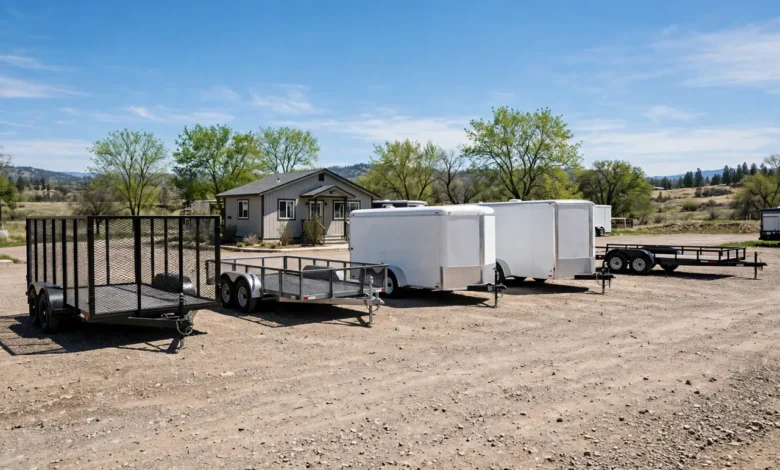
The trailers you will find in trailer sales near me fall into a handful of types, and each one is built for a different kind of work, so knowing the categories saves time when you start looking. Utility trailers are open, flat-bed trailers with low sides, and they are the most common choice for moving furniture, garden waste, building materials and ride-on mowers, because they are simple, cheap and easy to load. Enclosed cargo trailers have walls and a roof, which protects the load from weather and theft, and they are popular with tradespeople, motorsport teams and anyone who stores equipment in the trailer between jobs. Car haulers are built to carry vehicles, with ramps, tie-down points and a deck rated for the weight of a car, while dump trailers have a hydraulic bed that tips to unload soil, gravel or rubble without manual shovelling.
Flatbed trailers are open decks without sides, used for machinery, pallets and oversized loads that need a crane or forklift to load, and boat trailers are shaped specifically to carry a hull, with bunks or rollers and a winch post. There are also specialist types such as livestock trailers, food vending trailers and tiny-house trailers, but the five main types above cover the vast majority of what most buyers need. When you compare listings, pay attention to the trailer’s deck size, its gross vehicle weight rating and its axle configuration, because a single-axle trailer is cheaper and easier to manoeuvre but carries less weight, while a tandem-axle trailer carries more, tows more steadily and keeps going safely if one tyre fails. The type you choose should follow the heaviest load you realistically expect to carry, not the lightest one you hope to carry.
How Do You Work Out the Right Size and Weight Rating
Working out the right size and weight rating is the most important calculation in trailer buying, because getting it wrong either overloads the trailer or wastes money on capacity you never use, and it is the calculation that separates a confident purchase from trailer sales near me from a regretted one. Start by listing the heaviest thing you will carry and weighing it if you can, then add the weight of any other items that will travel with it, such as ramps, straps, fuel cans or tools, because the total is the payload your trailer must handle. The key number on any trailer is its gross vehicle weight rating, known as GVWR, which is the maximum total weight of the trailer plus its load, and your fully loaded trailer must never exceed it. The gross axle weight rating, or GAWR, is the maximum load each axle can carry, and it matters just as much, because an overloaded axle can fail even when the total weight is within the GVWR.
The second calculation is your tow vehicle, because the trailer is only half of the combination and your vehicle has its own towing limit set by the manufacturer. Check your vehicle’s handbook or the plate on the driver’s door for the maximum towing capacity and the maximum tongue weight, and remember that the trailer’s tongue weight, which is the downward force the trailer applies to the hitch, should be roughly 10 to 15 percent of the total loaded trailer weight for stable towing. Load the trailer with about 60 percent of the weight in the front half and 40 percent in the rear, because a tail-heavy trailer is the most common cause of dangerous sway at speed. If your vehicle cannot legally or safely tow the loaded trailer you need, then the honest answer is to buy a smaller trailer or a bigger tow vehicle, because no bargain is worth a combination that is unsafe on the road.
What Should You Inspect Before Buying a Trailer
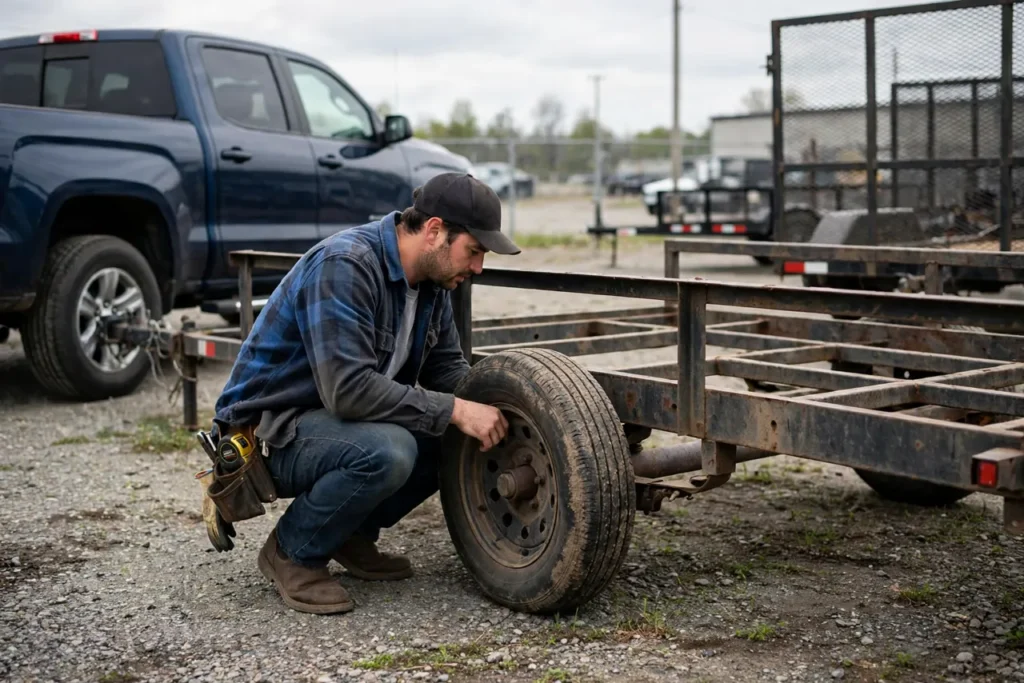
Before you pay for any trailer, inspect it in daylight with a torch and a checklist, because most serious faults are visible to a careful buyer and the ones that are not visible are usually found in the paperwork. Start with the frame, looking for rust, cracks, bent members and poor repairs, and pay particular attention to the tongue and the coupler area, because that is where the towing forces concentrate and where a crack is most dangerous. Check the axles for straightness and the springs or torsion arms for sagging, then spin each wheel and listen for grinding or roughness in the bearings, because worn bearings are a common and expensive repair on used trailers. Look at the tyres for cracks, bulges and uneven wear, and check their age, because trailer tyres often fail from age rather than from mileage, and a tyre that looks fine can be dangerously old.
Move on to the electrical and braking systems, because these are the parts most likely to have been neglected, and a trailer with faulty lights or brakes is not roadworthy. Test every light, including indicators, brake lights and number plate lights, and check the wiring for frayed insulation and corroded connectors. If the trailer has brakes, test them, and ask when they were last serviced, because trailers over a certain weight are legally required to have brakes in many jurisdictions and the threshold varies by state or country, so check your local rules before you buy. Finally, look at the deck or floor for rot, soft spots and damage, test the ramps and doors for smooth operation, and check that the safety chains, jack and spare wheel are present and in good order. A seller who welcomes a thorough inspection is usually selling a sound trailer, while one who rushes you is telling you something important.
How Do You Check the Title and Paperwork
The paperwork matters as much as the metal, because a trailer with a clean title and a clear history is a straightforward purchase, while one with missing or disputed paperwork can become a legal headache that no bargain price justifies. Ask to see the title or registration document and check that the vehicle identification number on the document matches the number stamped on the trailer, because a mismatch is a reason to stop the deal immediately. Check that the seller named on the title is the person selling you the trailer, and that there are no liens recorded against it, because a lien means someone else has a claim on the trailer and you could lose it even after paying. If the trailer has no title because it is very old or very small, check your local rules, because some jurisdictions do not title small trailers while others require registration regardless of size.
It is also worth asking for any service records, receipts for new tyres or brakes, and the original purchase documents if the seller still has them, because a trailer with a documented history is easier to value and easier to insure. If you are buying from a dealer, ask what warranty or return policy applies, and get it in writing, because verbal promises are difficult to enforce. If you are buying privately, consider a written bill of sale that records the price, the date, the vehicle identification number and both parties’ details, because that document protects you if any dispute arises later. Never hand over the full payment before you have seen the title and confirmed the numbers match, and never accept a promise that the paperwork will follow later, because a trailer without proper documents is a trailer you may not be able to register, insure or legally tow.
What Mistakes Do First-Time Trailer Buyers Make
First-time trailer buyers make a handful of predictable mistakes, and knowing them in advance is the cheapest insurance you can buy when you are choosing from trailer sales near me. The most common is buying too small, because a buyer who measures the trailer against a single planned load forgets the extra items that always travel with it, and discovers on the first real trip that the trailer is overloaded. The second is ignoring the tow vehicle, because a trailer that is perfect on paper is useless if the car or truck that must pull it is not rated for the weight, and the result is either an illegal combination or a vehicle that struggles on hills and in emergencies. The third is buying on price alone, because the cheapest trailer on the market is usually cheap for a reason, and that reason is often rust, worn bearings, bald tyres or missing paperwork that costs more to fix than the saving was worth.
Other common mistakes include forgetting to budget for the extras, because a trailer needs a hitch, safety chains, a jack, straps, a spare wheel and sometimes a brake controller, and those items add up quickly if they are not included in the sale. Some buyers also forget to check their local rules on trailer brakes, lighting, registration and speed limits, and discover after purchase that their trailer needs work before it can legally go on the road. Finally, many buyers skip the test tow, which is a mistake, because a short drive with the loaded trailer reveals sway, braking problems and handling issues that no amount of standing inspection will show. Take the time to tow before you pay, and if the seller will not allow it, treat that as information about the trailer rather than as an inconvenience.
Conclusion
Buying from trailer sales near me works best when you treat it as a careful purchase rather than an impulse buy, because the right trailer is the one that matches your heaviest load, your tow vehicle’s limits, and your budget, all at the same time. Start with the weight ratings, choose the type that fits your work, inspect the frame, axles, tyres, lights and brakes in daylight, and check the title and vehicle identification number before any money changes hands. Take a test tow with a realistic load, and walk away from any trailer whose paperwork does not add up, however attractive the price.
A well-chosen trailer will serve you for many years with little more than basic maintenance, and the time you spend choosing it is repaid every time you load up and tow with confidence. Compare several trailers rather than falling for the first one, budget for the hitch and accessories, and remember that the cheapest trailer is rarely the cheapest in the long run. Buy the trailer that fits the job, verify the paperwork, and enjoy the freedom that comes with being able to move what you need, when you need to.
How Much Does a Trailer Cost
The cost of a trailer varies so widely by type, size, age and condition that no single figure is useful, and any guide that quotes one price for all trailers is misleading. A small new utility trailer costs far less than a large new enclosed cargo trailer or a heavy-duty dump trailer, and a well-kept used trailer can cost a fraction of its new price, while a neglected one can cost more in repairs than it is worth. The honest approach is to compare several trailers of the same type and size in your area, check what is included in the price, and factor in the cost of a hitch, safety chains, straps, a spare wheel and any brake work that may be needed. Always inspect before you pay, and never let a low price override a failed inspection.
Do I Need a Licence to Tow a Trailer
Whether you need a special licence to tow a trailer depends on where you live, the weight of the combination, and the type of licence you hold, so the answer is different in different places. In the United States, most states allow towing within the limits of a standard driving licence provided the combination stays within the vehicle’s rated capacity, but commercial use and heavier combinations may require a commercial driving licence or an endorsement. In the United Kingdom, the rules changed in December 2021 so that most car licence holders can tow a trailer up to 3,500 kilograms, although the vehicle’s own towing limit still applies. Check your local licensing authority before you tow, because the rules are specific to your jurisdiction and they change over time.
What Size Trailer Do I Need
The size of trailer you need depends on the largest load you will carry, and the right way to work it out is to measure that load and add room for the straps, ramps and extra items that travel with it. A small utility trailer with a deck of around 1.2 by 2.4 metres suits garden waste, furniture and a ride-on mower, while a larger deck is needed for building materials, quad bikes or two motorcycles. For a car, you need a car hauler with a deck long enough for the vehicle and rated for its weight, and for bulk materials such as soil or gravel you need a dump trailer with sides high enough to hold the load. Always choose the trailer by its weight ratings as well as its dimensions, because the gross vehicle weight rating is the limit that matters most.
Should I Buy a New or Used Trailer
A new trailer gives you a warranty, a clean title, fresh tyres and brakes, and the confidence that nothing is worn out, but it costs significantly more than a comparable used trailer. A used trailer can be excellent value if it has been looked after, with a sound frame, good tyres, working lights and brakes, and clean paperwork, but it needs a thorough inspection because worn bearings, rusted frames and aged tyres are common and expensive to fix. If you are buying used for the first time, consider taking someone experienced with you, or paying for a professional inspection, because the cost of an inspection is small compared with the cost of repairing a bad purchase.
Do Trailers Need Insurance and Registration
Most trailers need to be registered, and the rules depend on where you live and on the size and weight of the trailer, so check with your local motor vehicle authority before you buy. Insurance is often covered partly by your tow vehicle’s policy while the trailer is attached, but a trailer that is stored, parked or detached may need its own cover, and valuable cargo usually needs separate insurance. Ask your insurer what is covered and what is not, and make sure the trailer’s value, its contents and any third-party liability are all accounted for, because a trailer that causes an accident can create claims just as a car can.