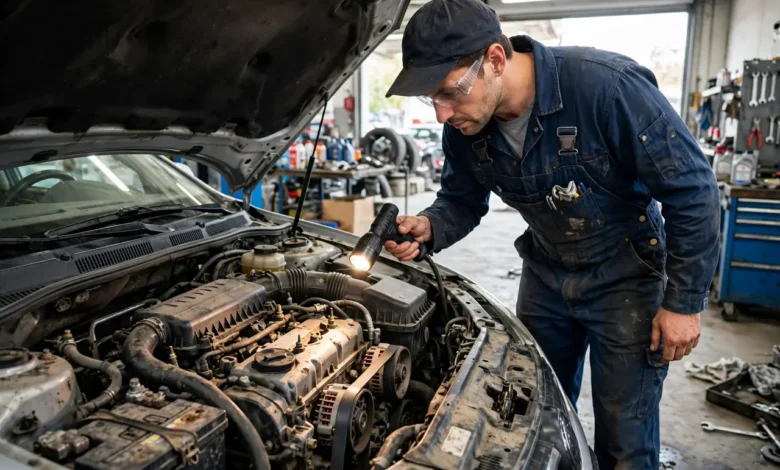
Vehicle Inspection Near Me: What a Pre-Purchase Inspection Checks Before You Buy
A vehicle inspection near me is an independent check of a used car by a qualified mechanic before you buy it, and a good pre-purchase inspection covers the engine, transmission, brakes, suspension, steering, frame, tyres, electrics and a diagnostic scan, followed by a road test and a written report. It is the single best protection against buying a car with hidden problems, because a seller can hide a fault behind a fresh valet and a short test drive, while a mechanic on a lift with a scan tool will find the worn brakes, the rusted subframe, or the fault code the seller cleared twenty minutes before you arrived. This guide explains what a vehicle inspection checks, when you need one, how to find a trusted inspector, and what to do with the report.
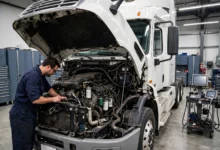
It is worth understanding what an inspection can and cannot do before you book one, because the value of the check depends on its scope, and a quick look around the car park is not the same as a full lift inspection with a diagnostic scan. A proper pre-purchase inspection takes the car off the ground, reads the computer for stored and cleared fault codes, measures the brakes and tyres, and drives the car to test how it behaves under real conditions, and the report that comes out of it gives you hard evidence to negotiate a lower price or walk away from a bad car. Spending a modest flat fee on an inspection before you sign is cheap insurance against a repair bill that could run into thousands, and this guide shows you exactly what you should expect for your money.
What Is a Vehicle Inspection?
A vehicle inspection is a systematic check of a car by an independent mechanic or specialist inspector, and in the context of buying a used car it usually means a pre-purchase inspection, which is a thorough examination carried out before ownership changes hands. The inspector works through the car in a fixed order, starting with the paperwork and the body, then the engine bay, then the underside on a lift, then the interior and electrics, and finally a road test, and everything they find is written up in a report with photographs and plain-language explanations. Unlike a routine service or an annual roadworthiness test, a pre-purchase inspection is done for the buyer’s benefit, not the seller’s, and the inspector has nothing to gain from the sale going through, which is what makes the report trustworthy.
There are different levels of inspection available, and the scope you choose should match the value and the risk of the car you are buying, because a cheap runabout and a high-value performance car deserve different levels of scrutiny. A basic inspection covers the visible condition of the body, tyres, brakes and fluids, while a comprehensive inspection adds a full diagnostic scan of every control module, a compression test and leak-down test on the engine, and measurements of brake pad thickness and tyre tread depth. Some inspectors also offer mobile inspections, where they travel to the car, which is useful when you are buying from a private seller or from a dealer in another town, and the best inspectors will walk you through their findings in plain language before you make your buying decision.
When Should You Get a Vehicle Inspection?
You should get a vehicle inspection whenever you are buying a used car, and it is most important when the car is expensive, when you are buying from a private seller with no warranty, or when the car is older or has high mileage, because those are the situations where a hidden fault costs the most. A dealer sale with a proper warranty still benefits from an inspection, because a warranty only covers what it says it covers, and an inspector can find problems that the warranty excludes or that would take weeks of arguing to get fixed. Even a car with a full service history deserves a check, because a stamped service book proves that oil changes happened, not that the clutch is healthy or the frame is straight, and a car that looks immaculate in photographs can still be hiding accident damage underneath.
There are also situations where an inspection is less urgent, such as buying a very cheap car where the inspection fee is a large share of the purchase price, although even then a basic check can be worth it if you are relying on the car for daily commuting. That is why a vehicle inspection near me is worth booking for almost any used car purchase, whatever the price, because the check is cheap compared with the repair it can prevent, and a clean report also gives you confidence in a car you are about to commit to. You should always get an inspection before you pay a deposit that you cannot get back, and never let a seller rush you into skipping it, because pressure to buy quickly is itself a warning sign. If the seller refuses to let an independent inspector look at the car, walk away, because an honest seller with nothing to hide has no reason to refuse, and the cost of the inspection is small compared with the cost of buying a car with a failing transmission or a bent frame.
What Does a Vehicle Inspection Check Under the Bonnet?
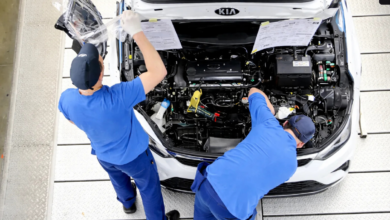
Under the bonnet, a vehicle inspection starts with the engine itself, and the mechanic listens to the engine running, checks the oil for a black, gritty or milky appearance that can signal neglect or a head gasket problem, and inspects the coolant, brake fluid and transmission fluid for level and condition, because low or dirty fluid often means the car has not been looked after. The belts and hoses are checked for cracks and wear, since cracked rubber can leave you stranded, and the battery is tested for strength, because a weak battery is easy to miss on a short test drive but expensive to replace at short notice. The mechanic also looks for signs of fluid leaks around the valve covers, oil pan and water pump, and checks that no parts are missing or have been fitted incorrectly.
Where the inspection is comprehensive, the mechanic goes further, performing a compression test and a leak-down test to assess the overall health of the engine, and inspecting the timing chain or belt for signs of stretch, slack or overdue replacement, because a timing failure can destroy an engine. The engine bay is also checked for signs of previous accident damage, such as bent panels, fresh paint in places where it does not belong, or non-factory welds, and the mechanic will look for rust on structural components, which matters a great deal in areas where winter road salt is used. A clean, well-maintained engine bay with fresh fluids and no leaks is a good sign, while oil sludge, coolant contamination or a strong smell of burning oil are all reasons to negotiate hard or walk away from the purchase.
What Does a Vehicle Inspection Check Under the Car?
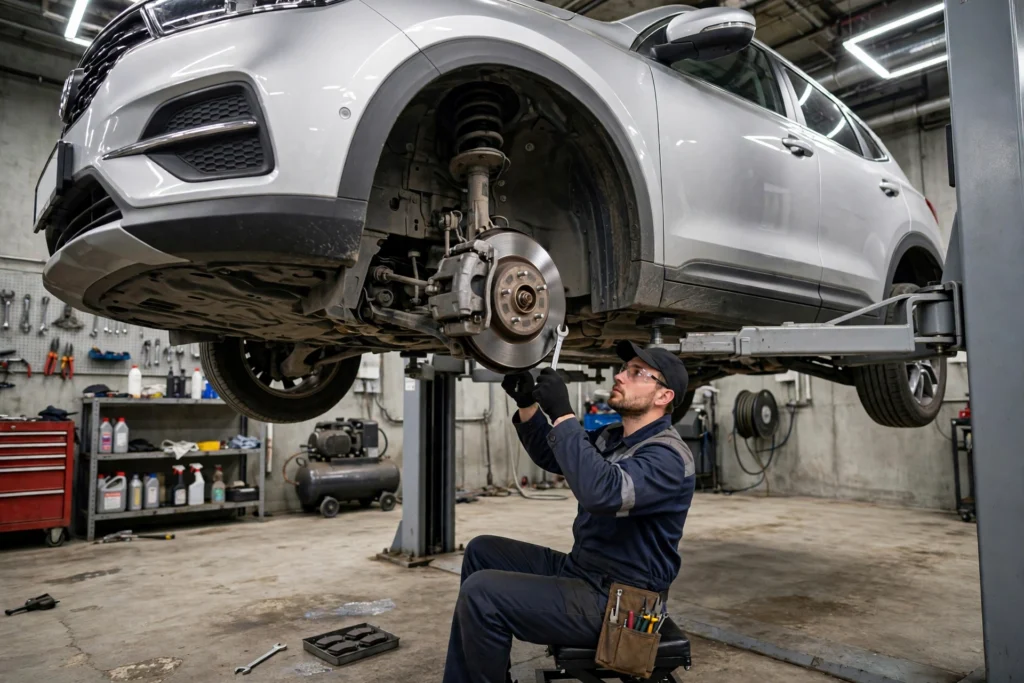
Under the car, a vehicle inspection puts the vehicle on a hydraulic lift, and that view from underneath is where many of the most expensive problems are found, because a car that looks perfect from above can have a bent frame, heavy rust or a leaking exhaust underneath. The mechanic inspects the frame and subframe for damage, rust and previous repairs, looking for bent metal, non-factory welds, mismatched undercoating and overspray that can reveal an undisclosed accident, and they pay particular attention to rust on the subframe, control arms and steel brake and fuel lines, because heavy rust in these areas can cost more to repair than the car is worth. The suspension is tested for worn ball joints, tie-rod ends, struts and wheel bearings, and any looseness or clunking is written down in the report.
The brakes get a close look as well, with the pads and rotors measured for wear, and the tyres checked for tread depth, age and uneven wear, which can point to alignment or suspension trouble, while the exhaust system is inspected for leaks, damage and corrosion. The steering components are tested for play and wear, and the mechanic checks the condition of the driveshafts, the differential and the underside of the transmission for leaks. This under-car inspection is the part of the process that a buyer simply cannot do on their own, because it needs a lift, good lighting and an experienced eye, and it is the main reason a professional inspection is worth paying for, since frame damage and structural rust are the two problems most likely to turn a bargain into a money pit.
How Does the Diagnostic Scan and Road Test Work?
The diagnostic scan is one of the most valuable parts of a modern vehicle inspection, because the mechanic connects a scan tool directly to the car’s diagnostic port and reads the stored and pending fault codes from every control module, including the engine, transmission, ABS, airbag and body systems. This matters because some sellers clear the check engine light with a handheld scanner shortly before a viewing, and a basic code reader will show no faults, while a proper scan can reveal permanent fault codes and incomplete emissions readiness monitors that expose the trick. The scan also shows whether the car has a history of faults that were never properly fixed, and it can reveal problems with sensors, such as faulty oxygen sensors or crankshaft position sensors, that cause misfires, rough idling and poor fuel economy without necessarily indicating deep engine damage.
The road test is the final part of the inspection, and the mechanic drives the car under real conditions to confirm how the transmission shifts, how the steering responds, and how the brakes feel when they are used properly. They listen for knocking, ticking or a rough idle, watch for shaking at motorway speed, grinding when stopping, or a gear change that hesitates, and check whether the car pulls to one side when braking or accelerating. The air conditioning and heating are tested, the lights, wipers, windows and locks are checked, and the interior is examined for water damage, because a damp carpet or a musty smell can mean a leak or even a past flood. Everything found on the road test goes into the written report, usually with a plain-English summary that tells you whether to proceed, proceed with caution, or stop and walk away.
How Much Does a Vehicle Inspection Cost?
A vehicle inspection is usually priced as a flat fee, and the exact cost depends on where you live, how thorough the inspection is, and whether the inspector comes to you or you take the car to their workshop, so you should always ask for a quote before you book and confirm exactly what is included. A basic inspection of a standard car is the cheapest option, while a comprehensive inspection with a full diagnostic scan, compression testing and a detailed photo report costs more, and inspections of larger vehicles, performance cars or electric vehicles can cost more again because they need specialist equipment and extra time. Some inspectors charge extra for travel if the car is far away, and a few charge a supplement for a same-day or weekend appointment, so it is worth asking about these extras when you call.
The important thing to remember is that the fee is small compared with the cost of the problems an inspection can uncover, because a single hidden fault such as a failing transmission, a rusted subframe or a timing chain that needs replacing can cost many times more than the inspection itself. When you compare the price of a vehicle inspection near me with the cost of a single hidden repair, the inspection is almost always the cheaper option, and it is the one purchase that can save you from buying the wrong car altogether. The report also helps with price, because if the brakes need work or something is leaking, you can ask the seller to lower the price or fix the fault before you buy, and a detailed written report gives you the evidence to negotiate with. Think of the inspection fee as part of the purchase price rather than an optional extra, and budget for it from the start, because the cheapest inspection is the one that saves you from buying the wrong car.
How Do You Find a Trusted Vehicle Inspection Near Me?
Finding a trusted vehicle inspection near you starts with looking for an independent mechanic or a specialist inspection company, rather than a garage that also sells cars, because independence is what makes the report honest, and a business that profits from the sale has an incentive to find nothing wrong. Look for inspectors with recognised qualifications, such as ASE-certified technicians, and check their reviews, because a good inspector will have a track record of detailed, photo-documented reports and plain-language explanations. Ask what the inspection covers before you book, and make sure it includes a lift inspection, a diagnostic scan and a road test, because a cheap inspection that only looks at the outside of the car is not worth much, and the best inspectors will tell you upfront exactly what they check.
You can find inspectors through a web search for your town or city, through motoring organisations and their recommended networks, or by asking a trusted local garage whether they offer pre-purchase inspections for buyers. When you call, ask how long the inspection takes, what the report looks like, and whether the inspector will talk you through the findings, because a good inspector is happy to explain the report in plain language and answer your questions. Avoid anyone who promises a guaranteed pass or who will not put their findings in writing, and be cautious of sellers who insist on using their own inspector, because the inspector should always be chosen by you, the buyer, and paid by you, so that their only loyalty is to you.
Conclusion
A vehicle inspection near me is the smartest money you can spend before buying a used car, because a qualified mechanic on a lift with a scan tool will find the hidden faults that a fresh valet and a short test drive cannot, from a rusted subframe and worn brakes to a cleared fault code and a failing transmission. A good pre-purchase inspection covers the engine bay, the underside, the brakes, tyres, suspension, electrics and a road test, and it ends with a written, photo-documented report that tells you whether to proceed, negotiate or walk away. Book an independent inspector, confirm what the inspection covers, and never let a seller rush you into skipping it, because the fee is small compared with the cost of buying the wrong car.
What Is Included in a Pre-Purchase Vehicle Inspection?
A pre-purchase vehicle inspection usually includes a visual check of the body and paint, an engine bay inspection with fluid checks, a lift inspection of the frame, suspension, brakes and exhaust, a diagnostic scan of the car’s computer for stored and cleared fault codes, an interior and electrical check, and a road test, followed by a written report with photographs. The exact scope varies by inspector and by price, so ask for a written list of what is checked before you book, and choose a comprehensive inspection for expensive, older or high-mileage cars.
How Long Does a Vehicle Inspection Take?
A vehicle inspection usually takes between one and two hours, depending on how thorough the inspection is and on the type of vehicle, with a basic check taking around an hour and a comprehensive inspection with a diagnostic scan and compression testing taking closer to two hours. Mobile inspections can take a little longer because the inspector has to set up at the location, and you should allow extra time for the inspector to walk you through the report afterwards, because that conversation is one of the most valuable parts of the service.
Can a Vehicle Inspection Find All Problems?
A vehicle inspection cannot find every possible problem, because some faults only appear under specific conditions, such as an intermittent electrical fault or a gearbox issue that only shows up when the car is fully warm, and no inspector can see inside an engine or a gearbox without taking it apart. A good inspection will find the most common and most expensive hidden problems, including frame damage, rust, worn brakes, fluid leaks and stored fault codes, and it will give you a clear picture of the car’s condition, but it is not a guarantee that nothing will ever go wrong with the car.
Should the Seller Be Present During the Inspection?
The seller does not need to be present during a vehicle inspection, although they usually need to make the car available and provide the keys, and many inspectors prefer to work without the seller watching, so they can examine the car freely and take photographs. What matters is that the seller agrees to the inspection and does not restrict access to any part of the car, and if a seller refuses an independent inspection or tries to limit what the inspector can check, that is a strong reason to walk away from the purchase.
What Should I Do If the Inspection Finds Problems?
If a vehicle inspection finds problems, use the written report to decide your next step, and the report’s plain-English summary will usually tell you whether to proceed, proceed with caution, or stop. Minor issues such as worn wiper blades or a weak battery can be used to negotiate a lower price or to ask the seller to fix them before you buy, while major problems such as frame damage, heavy rust or a failing transmission are usually a reason to walk away, unless the seller drops the price enough to cover the repair and you are comfortable taking on the work.
For help finding a trustworthy garage once you own the car, read our guide to Truck Repair Near Me: How to Find a Shop You Can Actually Trust, which explains how to judge a repair shop before you hand over your keys.